Sunday, February 20, 2022

A Book to Stop World War III? – The Captive Mind (1951)

“The historians do not speak of mothers’ despair or children’s distress ..."civilization" was built on the blood of the innocent.”[i] Czesław Miłosz 

If I could write a book review that would stop World War III, my whole life of love, study and suffering would be fulfilled. That would be the apex of my existence on Mother Earth, my infinite bow of gratitude.

DetailKyivSebastianMünster’s1552mapofPolandNHungary
It IS terrifying how the Warsaw Polish, Baltic states’, intelligentsia and artists’ whole populations’ Resistance movements; their annihilation and “assimilation” in Czesław Miłosz’s The Captive Mind, their demonization by Nazis and Stalin’s Soviet Union’s authoritarian regimes during and after World War II; once again resemble the threat to Kyiv (Kiev), Ukraine, and even echo its “almost complete”[ii] ruin during World War II, and also its devastation as far back as the Mongol invasion of 1240. When will we learn? “War is Hell.”[iii]  Why do we keep recreating it here on Earth?

Sack Of KIEV1240
Propaganda, national and world opinion are major battlegrounds. Maybe we have a chance to “compare facts,” to turn ALL the warmongers back. Say “STOP IT! JUST STOP IT!” as if to a bunch of angry, self-righteous two-year-olds arguing over a sparkling medallion, a line in the ever-shifting sands of time. The planet will not survive any more catastrophic wars, and we are already wasting Her magnanimous resources and our own lives, families and economies preparing for and waging them.

Miłosz’s “novel” was first published in 1951, six years after he survived the leveling of Warsaw, “almost a million inhabitants lost all of their possessions,” “a total of 650,000 (people) were displaced, deported or sent to concentration camps”[iv] and 

German_Troops_Setting_fire_to_Buildings_Warsaw_1944 
“Two hundred thousand people died in the street fighting,”[v] and/or were killed by 63 days of bombing, incendiary and SS squads in 1944, out of the previous more than one million residents of the city.

Warsaw,_January_1945-Świerczyński - Stanisław Jankowski, Adolf Ciborowski

We and the Ukrainians could be tempted into violent resistance and crushed the same way they were, but by even mo[vi]re cruel and immense powers. Or NATO could stand by idly while Russia “does the dirty work,” as Stalin’s forces did across the river from Warsaw while the Nazis completely destroyed the city, leaving only 900 residents remaining in the capital’s rubble.

“The ingenious methods by which the Stalinists isolate themselves from reality are amazing,” Miłosz warns us from the grave, and his portraits of four writers seduced or forced to surrender their talents to The Party after the takeover are chilling. In an authoritarian State, “Everything, thus, takes us back to the question of mastery over the mind.”[vii]

Ruined_Kiev_in_WWII_Wikip
“What is not expressed does not exist….Whoever reflects on “man” in general, on his inner needs and longings, is accused of bourgeois sentimentality. Nothing must go beyond the description of man’s behavior as a member of a social group.”[viii] 

“This line of reasoning… ignores the facts. The pressure of an all-powerful totalitarian state creates an emotional tension in its citizens that determines their acts.”[ix] If we've been unwary, we have been massaged into that same kind of internal disinformation barrage, taking on its folly, cowardice, mistrust and fear.

Like the Mongol hordes’ invasion, the terrible human legacy is that “we’ve seen this all before.” Miłosz introduces his chapter, “The Lesson of the Baltics,” with a reflection on “The rage one feels on reading sixteenth-century memoirs whose authors, mostly priests, recount the atrocities committed in America by Spanish Conquistadores …(We) cannot resurrect the Caribbean population slaughtered by Ponce de Leon, nor shelter the Inca refugees pursued through the mountains by knights fighting with faith and a sword…The historians do not speak of mothers’ despair or children’s distress…The civilization that calls itself Christian was built on the blood of the innocent…”[x]

The shift in technology has moved forward however, energizing Miłosz’ desire that thour human knowledge and responses not disappear. “A living human being, even if he be thousands of miles away, is not so easily ejected from one’s memory.” (Ukraine, Kyiv) (GEORGE PERRY FLOYD!) (Daunte Wright) (Afghan, [BIPOC, Southern, LGBTQ, Palestinian, Uyghur]) Women, children, elders, slaves, minorities, health care, agricultural and education workers…

“If he is being tortured, his voice is heard at the very least by those people who have (uncomfortable for them) a vivid imagination. And even if he is already dead, he is still part of the present; for the man who killed him or who gave the order that he be killed is sitting down somewhere, at some precise point on the face of the earth.”[xi] The news cycle may have sped up in our era, along with the excuses, distortions and erasures; but those of us “who have…a vivid imagination” do not forget.

And we must respond. “There must be, after all, some standard one dare not destroy lest the fruits of tomorrow prove to be rotten. If I think thus it is because for the last two thousand years or more there have been not only brigands, conquistadors, and hangmen, but also people for whom evil was evil and had to be called evil. Mass slaughter, the terror of revolution, the craze for gold, the misery of the working classes: who knows what dimensions these flaws might reach if every man believed he must keep silent and accept?”

Czesław_Miłosz_2011_Lithuania_stamp
“The invasion of the Spanish must have been an appalling experience for the Aztecs. The customs of the conquerors were incomprehensible; their religious ceremonies, strange; the paths of their thought, impossible to follow. The invasion of the Red Army was no less of a shock for the Estonians, Latvians, and Lithuanians.”[xii]

Would Putin make it a "soft" invasion and takeover? Is there such a thing? Like "consensual" rape and murder? Do we have that sort of propaganda and power battle going on here, in the United States, right under our noses? Vigilantes storming the Capitol building shouting such threats? Hunting down and shooting unarmed joggers and drivers “in self-defense?” What have we come to, morally?

Where classified documents “disappear” to the former President’s residence for nearly a year, to be copied by whomever or whatever “national interest” just might bail him out financially in exchange for those national security secrets? Where a close friend of the former President is “disappeared” “in an apparent suicide” in a Federal prison to prevent an embarrassing and scandalous trial and conviction for sex trafficking minors? Do not forget.

Use that “vivid imagination” and memory to picture what it would be if “one-party rule” returns to the U. S. in the midterms; even worse blocking of legislation, judicial and cabinet appointments; racist, sexist, authoritarian, violent and abusive falsehoods returning to the White House two years later! “Creeping fascism” has been with us at least since the 1960s and lay under the “Manifest Destiny” and “Doctrine of Discovery” propaganda that devastated peoples, cultures and continents. Nixon's resignation here when his corruption was exposed just drove it underground. We experienced four years of domestic disaster which are not yet over. Miłosz had to flee first to France and then to the U. S. to be able to tell us his tale.


Artur Pawłowski-1999Czeslaw_Milosz_ap

          He did not take up arms, he took up his pen – worked, wrote, spoke and taught. Every single one of us has skills, skills we can use to respond.

“When people are divided into “loyalists” and “criminals” a premium is placed on every type of conformist, coward, and hireling; whereas among the “criminals” one finds a singularly high percentage of people who are direct, sincere, and true to themselves.”[xiii] These are the antagonists and protagonists in his "novel." Like Charles Dickens’, their personae, characterizations and problems are contemporary with this immediate, difficult, seemingly divided world.

Under tunnel vision, totalitarian-style propaganda and factlessness, “This way of treating literature (and every art) leads to absolute conformism…” Creativity, curiosity and even inquiry is stifled, deflected and contained because “The creative act is associated with a freedom that is, in its turn, born in a struggle against an apparently invincible resistance. Whoever truly creates is alone.”[xiv] “In rebelling, I believe I protect the fruits of tomorrow better than my friend who keeps silent. I assume the risk and I pay.”[xv]

Kings_Castle_Square,_DestWarsaw,_1945

This is the voice of Miłosz, a writer who won the Nobel Prize for Literature in 1980 and said in his acceptance speech, “The paramount duty of the poet… is to tell the truth.” How could we "tell the truth" if we're constantly awash with runoff spouted from gigantic and overwhelmingly well-funded silos of excrement right next to us full of lies?

Capitalism creates fear, subservience and conformism due to want, competition, greed and materialist poverty in a pyramidic Ayn Rand hierarchy; the intense pressure on the individual abandoned and isolated from others and thourselves, scrambling to “succeed” and survive; but the flattened mass of totalitarian-ruled populations under the thumbs of the 1% Party members perpetually spying on and manipulating each other and their citizens with terror, secret police and propaganda is certainly not better. It’s just a matter of counting the hidden bodies, hungry children and “detained” minority "undesirables" in thour military-industrial-technocratic-prison complexes.

Four journalists analyzed the “Effects of January 6th on Political Culture” on thePBS News Hour of the 2022 anniversary of the riot,[xvi] but only one of them, Stuart Stevens, courageously called the insurrection “part of a larger autocratic movement in America,” people who feel they have an obligation to “overturn the will of the people” from a free and fair election in such an extreme way that they are living in a “fantasy.”

“You can’t negotiate with evil. People who are evil, a person in the Capitol wearing a Camp Auschwitz T-shirt? You don’t want to ‘meet with those people halfway.’ You don’t need to ‘understand them.’ They’re wrong. People who believe in democracy are right. You have to beat these Republicans and have more days like January 5th last year where you elect Democrats in Georgia. We’ve had flaws in democracy for 30 years, but we need representatives for democracy now. More events like January 6th will happen.”[xvii]

The 99% INCLUDES a guy I saw in Florida in a DEFUND BERKELEY T-shirt, duped by both a left wing extreme meme (“Defund the Police”) and right wing gossip and haranguing into thinking an election was "stolen" so we fight and target each other while the oligarchs and Boards of Directors of the 1% laugh all the way to the bank.

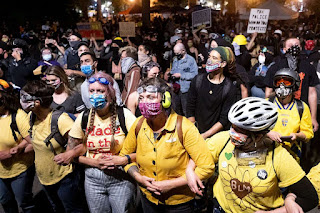
The contrast between how the former President, “his” “loyal” Republicans, enforcers and FOX News tear gassed, attacked, kidnapped, mass arrested, surveilled, denied and vilified the BLM peaceful protesters last year; yet used his militarized might; his coddling, elevating and encouraging of the deadly and dangerous January 6th rioters; MUST GIVE US PAUSE. These need to be seen as tactics of totalitarian governments, not a democratic republic.

July 20, 2020 Portland, OR
Like those of both Hitler and Stalin, the treatment of “criminals” (nonviolent protestors) and “loyalists” (toadying politicians and their violent, unquestioning followers) in the U.S. and Ukraine need to be seen as political culminations domestically and internationally parallel to recent Hungary and other democratic or neutral peoples’ and countries’ usurpation by dictatorial regimes, as well as the "justified" invasion of Ukrainian sovereignty by Russia. It is all of one, fetid, feral and fictitious stream.

 “If he is being tortured, his voice is heard at the very least by those people who have (uncomfortable for them) a vivid imagination. And even if he is already dead, he is still part of the present; for the man who killed him or who gave the order that he be killed is sitting down somewhere, at some precise point on the face of the earth.”[xviii] The news cycle may have sped up in our era, along with the distortions, erasures and “real time” videographic revelations, but those of us “who have…a vivid imagination” DO NOT FORGET.

And we must respond…

Miłosz, Czesław, translated from the Polish by Jane Zielonko, The Captive Mind, Vintage Books, New York, NY, 1955, [1953], originally published by Alfred A. Knopf (USA) and in Canada by McClelland and Stewart Limited. p. 223-24.

Wikipedia, The Free Encyclopedia, (28 December 2021)  “Destruction of Warsaw,” https://en.wikipedia.org/wiki/Destruction_of_Warsaw   (20 January 2022)


[i] Miłosz, Czesław, translated from the Polish by Jane Zielonko, The Captive Mind, Vintage Books, New York, NY, 1955, [1953], originally published by Alfred A. Knopf (USA) and in Canada by McClelland and Stewart Limited. p. 223-24.

See also, (23 February 2022) “Czesław Miłosz,”  https://en.wikipedia.org/wiki/Czes%C5%82aw_Mi%C5%82osz   (24 February 2022) “In the preface to his 1953 book The Captive Mind, Miłosz wrote, "I do not regret those years in Warsaw, which was, I believe, the most agonizing spot in the whole of terrorized Europe. Had I then chosen emigration, my life would certainly have followed a very different course. But my knowledge of the crimes which Europe has witnessed in the twentieth century would be less direct, less concrete than it is."

[ii] Wikipedia, the Free Encyclopedia, (24 February 2022) “Kyiv,” https://en.wikipedia.org/wiki/Kyiv    (24 February 2022) San Francisco, CA, USA.

[iii] ----- ibid., (May 1865) “William Tecumseh Sherman,” https://en.wikipedia.org/wiki/William_Tecumseh_Sherman   (24 February 2022) “I am tired and sick of war. Its glory is all moonshine. It is only those who have neither fired a shot nor heard the shrieks and groans of the wounded who cry aloud for blood, for vengeance, for desolation. War is hell.”

See also (23 February 2022) Gen. William Tecumseh Sherman (16 February 2022)  https://www.searchquotes.com/search/War_Is_Hell/#ixzz7LqAjuT2v (24 February 2022)

Warning to Southern Secessionists from Wikipedia, above. (1860) “You people of the South don't know what you are doing. This country will be drenched in blood, and God only knows how it will end. It is all folly, madness, a crime against civilization! You people speak so lightly of war; you don't know what you're talking about. War is a terrible thing! You mistake, too, the people of the North. They are a peaceable people but an earnest people, and they will fight, too. They are not going to let this country be destroyed without a mighty effort to save it ... Besides, where are your men and appliances of war to contend against them? The North can make a steam engine, locomotive, or railway car; hardly a yard of cloth or pair of shoes can you make. You are rushing into war with one of the most powerful, ingeniously mechanical, and determined people on Earth—right at your doors. You are bound to fail. Only in your spirit and determination are you prepared for war. In all else you are totally unprepared, with a bad cause to start with. At first you will make headway, but as your limited resources begin to fail, shut out from the markets of Europe as you will be, your cause will begin to wane. If your people will but stop and think, they must see in the end that you will surely fail.” (24 February 2022)

[iv] Wikipedia, The Free Encyclopedia, Op. Cit. (28 December 2021)  “Destruction of Warsaw,” https://en.wikipedia.org/wiki/Destruction_of_Warsaw    (20 January 2022)

See also “Almost a million inhabitants lost all of their possessions.[9] The exact losses of private and public property, including pieces of art, other cultural artifacts and scientific artifacts, is unknown but must be considered substantial since Warsaw and her inhabitants were the richest and wealthiest Poles in pre-war Poland.

 In the course of the Warsaw Uprising and its suppression, the Germans deported approximately 550,000 of the city's residents and approximately 100,000 civilians from its outskirts, ... The security police and the SS segregated the deportees and decided their fate. Approximately 650,000 people passed through the Pruszków camp in August, September, and October….

Material losses were estimated at 10,455 buildings, 923 historical buildings (94%), 25 churches, 14 libraries including the National Library, 81 primary schools, 64 high schools, the University of Warsaw, the Warsaw University of Technology, and most of the city's historical monuments.[9]

The human toll, from Wikipedia and The Captive Mind First person witness:

             15,000 d. Warsaw Ghetto uprising, 1943;

             Warsaw Resistance uprising, Miłosz: “The revolt of a fly against two giants.” (p. 96) “Two hundred thousand people died in the street fighting,” (p. 94, The Captive Mind,) and/or killed by 63 days of bombing, incendiary and SS squads in 1944, (out of the previous one million residents of the city);

             a total of 650,000 were displaced, deported or sent to concentration camps.

             April 1945, “its demolished streets literally cemeteries …mounds of rubble…We spent several hours in a once familiar part of the city. Now we could not recognize it… total silence…” (ibid., p 64).

Other sources:

History (2020) “The destruction of Warsaw: the Nazi plan to obliterate a city,” https://www.history.co.uk/article/the-destruction-of-warsaw-the-nazi-plan-to-obliterate-a-city     AETN, UK, (20 February 2022)

DuckDuckGo – “population of Warsaw before Nazi destruction” (20 February 2022)  https://duckduckgo.com/?q=population+of+Warsaw+before+Nazi+destruction&t=ffsb&ia=web   (20 February 2022)

[v] Miłosz, Czesław, Op. Cit. The Captive Mind, p. 94.

[vi] Ibid, p. 237.

[vii] ----, p. 197.

[viii] ----., p. 215.

[ix]  ----., p. 209.

[x]  ----. p. 223-24.

[xi]  ----., p. 224.

[xii] ----., p. 227.

[xiii] ----, p. 209.

[xiv] ----, p. 217.

[xv] ----, p. 225.

[xvi] PBS News Hour, interview by Judy Woodruff of Stuart Stevens, Gary Abernathy, Jelani Cobb, George Packer (6 January 2022) “Jan. 6 attack was a ‘warning shot’ and likely a ‘harbinger,’ experts say. Here’s why.” https://www.pbs.org/newshour/show/jan-6-attack-was-a-warning-shot-and-likely-a-harbinger-experts-say-heres-why   (24 February 2022) (Transcript) WETA-TV, Washington, D.C., USA.

[xvii] Ibid.

[xviii] Miłosz, Czesław, Op. Cit. The Captive Mind, p. 224.

Saturday, February 5, 2022

The Fire Trail - Ustenci

The Fire Trail: A Mother's Journey Through Grieving

The Fire Trail: A Mother's Journey Through Grieving by Maureen Larkin Ustenci
My rating: 5 of 5 stars

      Maureen Larkin Ustenci in her The Fire Trail: A Mother’s Journey Through Grieving, at first tells “an absurd mix of everything good and bad about him;” Efejon, her and husband Mustafa’s only child. Teen angst, college-bound, partying with his buddies preface his sudden death the week after graduation, not quite 18, in 2016.

      Shock, denial and questioning assail her; but she and Mustafa are extremely fortunately swept up and surrounded by family, friends; the Turkish, Berkeley High School, Ultimate Frisbee and other communities as their lives collapse. People who adored or barely even knew their unique, emotional, enthusiastic and charismatic son show up. By the hundreds.

     This is a memoir that welcomes you into fellowship with a very human, fallible and truthful author. “I put the phone down and put my head down and cried so hard that it felt like my throat was tearing and my eyes were being pushed out of their sockets,” as well as, reading Rumi poetry that someone gave her, “that person is gone forever, and the only remaining way to love them is to love them with no thought of any return, selflessly.”

     Never preachy or whining, deeply grateful; she describes changes, thoughts and feelings as she goes along, like “there has been nothing so healing for me – … as being with Efejon’s friends… they remind me over and over that… Efejon’s life – not his loss – was what mattered.” “Torn out of that grand procession of life, out of that harmony and that rhythm,” she ticks off other family disasters and says, “none of this is even particularly bad luck. It’s just life.” 

     Breakdown, horror, despair, dissolving, self-abandonment -- then support, moments of survival, shreds of courage, mountains of love, one foot in front of the other, slowly recontextualized into a bigger picture, never entirely "the same." 

     An outstanding volume, directly and skillfully created in honor of a dear young man; chronicling his extraordinary and also "ordinary" Mother's grief. 

     Thank you. Bless all of you. Tell the tale. Endure… 

(The Berkeley Times, Knox Book Beat, 10 February, 2022)

View all my reviews

Friday, January 7, 2022

Deep Hanging Out with Malcolm Margolin, & Native News


 Deep Hanging Out: Wanderings and Wonderment in Native California by Malcolm Margolin

My rating: 5 of 5 stars

Deep Hanging Out: Wanderings and Wonderment in Native California is a truly wonderful collection of Malcolm Margolin’s forewords to books he’s published at Heyday, selections from his own books, including The Ohlone Way: Indian Life in the San Francisco–Monterey Bay Area, and many of his articles and interviews from News from Native California, a quarterly magazine devoted to California’s Indigenous peoples, founded by Malcolm, David Peri, and Vera Mae Fredrickson in March of 1987. 

“Ah, Berkeley, a place of bookstores, libraries, coffeehouses, and (at that time) surrounded by large amounts of open space,” he waxes. A marvelous jumping-off place and welcoming hearth for his many meanderings and meetings in between 40 years leading Heyday, the independent nonprofit publisher and cultural institution which he founded in 1974 when he self-published his The East Bay Out: A Personal Guide to the East Bay Regional Parks, and his now maybe even more marvelous dot-org, California Institute for Community, Art & Nature.


Born in 1940, Malcolm Margolin came to Berkeley with his wife Rina in 1970 after two years hippieing around North America in a VW bus, and has been here ever since. He had grown up in a Jewish section of Boston where the older generation spoke Yiddish and “Jews, like Indians, have a long history of being rejected and oppressed…have experienced genocide…practicing a spirituality and using a language not readily available to others…Food and other traditions bound us together; a sense of tribalism prevailed.”
He says, as well, “I was constantly surprised,” as he “hung out” with N. CA Indians; probably because people could sense his kindness, honesty and curiosity; speaking to him in ways they would not have spoken to others; revealing themselves because they knew he would represent them clearly and fairly.
 

But represent them, he does; and by doing so, as well as researching news reports, ethnographies and settler histories; he is mirroring thourselves as colonizers more clearly back to us in contrast, often demythologized of Savior and Lone Ranger heroics. In the belly of the Hearst Museum with three regalia-making Indian families among the “woodpecker-feather headdresses, obsidian blades of great size and rare color, white deer skins, civet-skin kilts, dentalia necklaces,” of his article on “Wealth and Spirit (1993),” for example, he gently and patiently explains:
 

“It is difficult for outsiders to understand regalia (ceremonial/ritual/dance adornments) and the role it plays in the lives of the Native people of northwestern California. The dominant culture does not have anything quite like it, and the language and thought structures by which outsiders attempt to describe regalia never quite fit.”


And then he goes on to do so, using the descriptions of the Indians’ responses, the regalia itself; its uses, “being” and “aliveness” in the social contexts of tribal life and spirituality; his feelings and observations as they share, touch, examine “material culture” in the Hearst as Julian Lang explains how “The wealth system of northwestern California brings together the earth, nature and spiritual enlightenment.”…Ending with “a reminder that “we are descended from a people who made beauty and who used that beauty, to fix the world.” Aho!
 

Reading these pages is like getting 200 miles out of town at night, pulling over, turning off the car, walking out into a meadow, hearing nothing but the wind and looking straight up at the thousands of stars in the sky. We are nothing. We are tiny. We are just a piece of a cosmos that barely cares if we snobby, over-mechanized and material-acculturated humans live or die.
 

Remember that? We have emotional, biological, neurological and ancestral memories of how that was in the thousands of years we spent in hunter-gatherer times. When life in nature itself was awesome. And being in a small, well-known community of interdependent humans who knew we had to depend on each other and follow the sharing traditions and earth conservation so it all would go on and we could survive. For Native Americans, them, (we/them) it wasn’t that long ago.


If only the missionaries/ settlers/miners had had Margolin’s curiosity, humility, respect, breadth of mind!…The Native Californians even share their grief with him of “What Has Been Lost,” the magnitude of “damage done to traditional culture…” and how “to rebuild the self, one first must come to terms with and acknowledge the fullness of loss.”
 

They carve out of the darkness, not only with courage, but with song, strength and humor. “Deal with what we have and work with what we have…sense the presence of the ancestors” “standing around saying ‘Listen, they’re singing that song again! Isn’t it great? They’re so cute; they’re singing it all wrong, they don’t even know what they’re talking about. It’s so wonderful.’ In that way, you do have to be careful about how you use the songs and ceremonies. But there’s also that element of intent that is so important in connecting back.”


And in dealing with anger, Greg Sarris tells him what Mabel McKay said, “You’re going to let holes grow in your heart, hatred and poison will grow there, and you’re going to poison yourself and you’re going to poison other people….You have another choice. All the things that have happened to you,” she said, “could become medicine. This is an opportunity to doctor." 

And more, and more, and more.


From his obvious respect for the individuals, cultural and historical backgrounds of Native Californians; the persistence and generosity of his research, listening to, recording and elegantly writing about their worldviews, experiences and resounding “stories;” I have no doubt of his sincerity and humility in this project. 

Others may “play Indian,” snatch fragments for the marketplace, further colonize and insult by appropriating and profiteering, but not Malcolm. He could not have heard all this from them without “walking his talk.” By listening, and by choosing so ably what and how to share. 

As Vincent Medina told him, “We learn with the heart.” Tappe ta-ak hin-nan. And as he says, “I feel that the Indian world has a great deal to teach the rest of us…Beauty and wisdom abound.”


View all my reviews


Bridging Parallel Worlds

A Spy in the Struggle

A Spy in the Struggle by Aya de León
My rating: 5 of 5 stars

Aya de León, Creative Writing teacher in UC Berkeley’s African-American Studies Department, weaves a rough-and-ready novel around the consciousness-raising issues of what “defunding the police,” “disaster capitalism” and climate crisis justice have in common. 

Through the “coming of age” of her main character, Yolanda Vance, de León explores how a person who thought they knew, can learn “the Real history” of race, gender, privilege, power and pollution in America at ground level. 


Yolanda grew up in Georgia, got scholarships to prep school and a women’s college that looks a lot like Mills and takes a job infiltrating a grassroots climate change organization. By going undercover with activists opposed to an East Bay government contractor, she finds herself on the wrong side of the law as well as her gut feelings, childhood intuitions, eroticism, moral values, legal expertise and heart. 

The two separate “silos” of Yolanda’s federal police work and the “Red, Black and Green” (RBG) teens and activists she’s been sent to surveille jostle for dominance with her consciousness, upbringing and “education” to bend and penetrate her tough and naïve surface masquerades. She starts transforming her vision of what she was told were her employer’s “regrettable” (murderous) 1960s “tactics” into the reality of cover-ups, disappearances due to immigrant status, greed, fact and data manipulations and denial all around her. 

At rock bottom, de León uses her “experience in the anti-nuclear movement as a teen in the 80s… the Livermore Action Group in South Berkeley,” in the Black community in Roxbury, Massachusetts and “with the climate initiative of the Movement for Black Lives” as excellent detail material for her fast-moving action; diverse, lively characters and outstanding flair for dialogue that moves Spy along smartly.

 As fiction, she doesn’t name names here or dwell on current events, but the lines are pretty clearly drawn from East Bay life where we all know who gets “cheap land, a freeway, a place to dump their toxic waste and don’t have to pay a cent in taxes…(I)t’s not enough (for BIPOC) to have a handful of custodian jobs ---“ “…our people were the ones dying, while the employees … who live in cozy white suburbs worked from home” when COVID hit. Ouch! Hey, Sistah, tell it like it is!

Like my political “deflowering” hearing about and witnessing the police riots of 1968 in Chicago and at University of Wisconsin anti-war sit-ins; Yolanda doesn’t want to believe it’s really happening, that corruption really goes down that deep or spreads out that far. Or that her own actions, like Meridel LeSueur yelled at do-gooder dummy me in 1980, were going to “splinter the movement! That’s counter-insurgency,” a knee-jerk habit of infighting all-too-common in liberal and radical left orgs letting competition and egoism open the doors to distrust, confusion and provocateurs.

 
As I straggled into the Orlando, Florida airport motel three days before a visit to Mom for Thanksgiving; a wiry white man with crisp, short grey hair; a sneering, angry look and a yellow-on-black “DEFUND BERKELEY” T-shirt was being dragged out of the breakfast area by his exhausted-looking younger wife or daughter. I rolled my eyes and went about my business, but the image stuck in my mind:
 

“DEFUND BERKELEY?” “What the hell does that mean?” on the one hand (besides “Please get in a fight with me!”), and “Good luck with that!” on the other. (Would that include “defunding” Livermore Labs and Cal? I think not.) 

Soon after that, a massive storm of tornadoes flattened whole towns in Western Kentucky, hitting already impoverished, jobless and homeless people especially hard; and last week 600+ homes were destroyed and tens of thousands evacuated in Colorado wildfires with winds up to 100 miles an hour. As Marvin Gaye called out to us in his 1971 hit release, “What’s Going On?” “We’ve got to find a way, to find some loving here today…Don’t punish me with brutality, talk to me…What’s going on?”

On the first anniversary of the U. S. Capitol insurrection and riot, disaster and disunity signal major human misunderstandings about each other and the world around us on which we tenuously depend. The difference between the huge police, National Guard and White House responses to the peaceful Black Lives Matter and Wall of Many protests and the former President’s absence of planning, ugly encouragement and then despicable apathy and lies during and after the January 6th insurrection.
 

The 99% INCLUDES people duped into thinking an election was stolen, so that we fight EACH OTHER while the Boards of Directors and real estate barons laugh all the way to the bank.
 

Marcus, the head of the RBG teen and neighborhood center, says about a white attorney working for them, “He clearly had no idea what kind of violence the government has done in our community.” Neither does a guy in a DEFUND BERKELEY T-shirt. What violence has been done to “THEM,” too.

When Mr. Floyd called, “Mama, I’m through!” he was calling to ALL OF US in the human family to get smart, listen to each other’s truths and help each other and the Earth SURVIVE. 


Listen to the youth!
We demand the truth!

It is our duty to fight for (th)our freedom
It is our duty to win
We must love and support one another
We have nothing to lose but (th)our chains


View all my reviews


Sunday, December 5, 2021

A Mixed Bag* -- Cervine, Stageberg & Moody

Poetry, Story, Novella -- Reprint from the 4 November, 2021 Knox Book Beat, The Berkeley Times, © 2021, Wyndy J. Knox Carr

I was getting ready for Seasonal Affective Disorder (the “Winter Blues”) by stocking up on a variety of writers and genres, in spite of most of the dry, sunny California "winters" I’ve experienced since 2012. Long-time residents tell me it used to rain for four months straight in The Bay Area, and they had lots of time to curl up and read. Anyway,

People finally attended an in person (outdoors) poetry reading August 29th for Sixteen Rivers Press with readers Stella Beratlis and Dane Cervine. What fun! 


It was in the garden behind the Northbrae Community Church on the Alameda, where both readers were excellent, and all well-managed; but as a Northern California poet who “lived in Berkeley on Bienvenue” during grad school, Cervine donated BTx a copy of The World is God’s Language: Prose Poems.

Thank you! As I lazed in the shade of the warm afternoon, his “kind of blended American haiku and haibun in prose-poem format” lifted my tech-befuddled brain out of my weary body and quickly made my cellphone irritating, but totally irrelevant. The present moment, as the Buddhists say, took over, as Cervine seemed to be in each of his short prose poems.


His title comes from Simone Weil,* another mystic he admires, but remembered more for her philosophically and politically minded writings and activities. His poems are clear human images taken “from life;” stripped down into real, contemporary, but also beatific “Histories,” “Bali,” “World” and “Colors of the Underworld.”

Looking in and looking out from a centered place is what spiritual and creative practices give us all, and gives Cervine a place of words and heart to stand in while small-minded “Gated Communities” fight over who will have “the privilege of being the last to starve” outside. 

The Big Picture is his universe, expressed in authentic images from his intimately human and caringly connected mind and life. He is so bare, so courageous, I cannot help but admire his work and hope to seek out his other six books.

Weil had a mystical experience at the Porziuncola, St. Frances' chapel just outside the town of Assisi in Umbrian Italy, where I also felt overcome by the power of contemplation. (The tour guide had to drag me out of one of the pews to "keep up with the group," I was so transported.) The tiny Romanesque chapel is now surrounded by a huge, Baroque basilica, but the chapel of Santa Maria Degli Angeli is like a storehouse radiating energy. 

I just had to reproduce the photo here during the Nativity Solstice season! 


I have great respect for Sixteen Rivers Press, “a sustainable, shared-work publishing collective run by and for Bay Area poets.” We Berkeley poets who hang out at cafes like Nefeli (NOW CLOSED! Oh no! "merged with A & V" Wonderful baklava and espresso…) and read at poetry readings there and  Le Bateau Ivre (The Drunken Boat – still open – Thursday through Sunday! Patio seating, and 25% indoors) on Telegraph Avenue, deeply appreciate their support of poetry, writing, writers, independent bookselling, distribution and publishing.

Bruce Moody, Berkeley poet and writer, toys with such feelings in “The Jaunt,” the last and perhaps most engrossing and climactic of the 26 fine “works of regional prose storytellers” in the Carquinez Review 2020: Writings from the Carquinez Strait Shoreline Communities. Blind reviewed by a sagacious selection panel, edited and published by the Benicia Literary Arts with beautiful photography and design, this volume is truly a marvel of what a dedicated team of professionals, semi-professionals and community members can do.

Mr. Moody wrote in his BTx poem “Trompe 2016,” “Because self-pity is the sole noise available to the duped,/ we whined for compassion./ And tromped ourselves.” But “The Jaunt” is a third person narrative that goes to the edge of thour delusionary blunders of humanity and self-ignorance, but then knows somehow, a more authentic way, true-to-self-and-thour-world and then returns, relatively unscathed and newly whole in the person of the observed observer, “He.”

And that self is very honest, and the self is really real, in a real Northern California place, person and time that rings with both questioning inquiry and the risky verisimilitude of being on the edge. I won’t say any more than that, except Moody did a fine job, and people should look for the Carquinez Review 2020 on the Benicia Literary Arts site. Holiday time is almost here! Treat yourself or treat a friend…

Mia Kirsi Stageberg’s novella, Everything For the Beloved, published by Berkeley’s Beatitude Press in 2010, was another real gem. It’s from another new sub-genre of writing, Creative Nonfiction, married to the old epistolatory novel that gives voice to seven of her blood ancestors and their/her intertwining short narratives and points of view in a mere 50 pages.

Its depth, honesty and intimate, homespun-to-contemporary lyricism just “knocked my socks off,” Rashomon in chorus, or a Scandinavian-American mini There, There. The idea that this little, dark-jacketed booklet could grab me to the core was astounding. So glad she sent it to me after meeting me at the Ralph Walbridge memorial. I just love the literary crossroads of Berkeley and the Bay Area.

Sixteen Rivers is having an online benefit reading through eventbrite 3 p.m. this Sunday November 7th, too, and are sponsoring a Youth Poetry Contest. See their sixteenrivers.org site. Be aware, be present, be humane…


*“The bag referred to here is a hunting bag containing the different kinds of animals and birds that the hunter has shot.” Collins COBUILD Idioms Dictionary, 3rd ed. © HarperCollins Publishers 2012

**For Weil, "The beautiful is the experiential proof that the incarnation is possible". The beauty which is inherent in the form of the world (this inherency is proven, for her, in geometry, and expressed in all good art) is the proof that the world points to something beyond itself; it establishes the essentially telic character of all that exists. Her concept of beauty extends throughout the universe:

"[W]e must have faith that the universe is beautiful on all levels...and that it has a fullness of beauty in relation to the bodily and psychic structure of each of the thinking beings that actually do exist and of all those that are possible. It is this very agreement of an infinity of perfect beauties that gives a transcendent character to the beauty of the world...He (Christ) is really present in the universal beauty. The love of this beauty proceeds from God dwelling in our souls and goes out to God present in the universe".

She also wrote that "The beauty of this world is Christ's tender smile coming to us through matter".[72]

Beauty also served a soteriological function for Weil: "Beauty captivates the flesh in order to obtain permission to pass right to the soul." It constitutes, then, another way in which the divine reality behind the world invades our lives. Where affliction conquers us with brute force, beauty sneaks in and topples the empire of the self from within.

Wikipedia, The Free Encyclopedia, (28 November 2021) https://en.wikipedia.org/wiki/Simone_Weil "Simone Weil." (5 December 2021)

Sunday, November 21, 2021

Shoulders to the Wheel, Holiday Hugs All Around

 Out of My Shoes: a Memoir by Meredith Stout and Book of Itzolin: Life and Works of Itzolin Valdemar García, collected and edited by his Mother, Mia Kirsi Stageberg, are models for women putting thour shoulders to the wheel of change.

The ingrained, habitual sufferings of women, mothers, girls and thour children are degrading, destructive and murderous. Creation spirituality theologian Matthew Fox calls thour destruction of Mother Earth “matricide,” and poet Jane Hirshfield calls it something like “biospheric suicide.” The effects on thourselves, thour children and societies continues to be onerous, in spite of some scientific, mechanical progress that has “made our lives ‘easier.’” But at what cost?


I asked a woman neighbor of mine “So what happens when we sit in our apartments feeling sorry for ourselves?”

She replied, “I don’t know.” So I said,

“Nothing!”

Nothing happens. Nothing changes at all, and we just habituate the misogyny and destruction all around us into thourselves.


Stout, publishing through Driftword Press, tells the story of her life from her 1950s sheltered childhood in Altadena, where her brother got to go to an expensive college prep school, but she and her sister went to public schools. Their Mom said, “Aren’t you glad you got to have horses instead?” The girls agreed dutifully. Until they didn’t. Through her Berkeley faculty wifehood, she nodded and agreed, drank and gave dinner parties, but then picked herself up, took a job, moved out and tells a gripping and powerful story of friendship, self-examination and finding her true callings.

Stageberg’s collection of her son’s poetry, novella and other writings, Book of Itzolin: Life and Works of Itzolin Valdemar Garcia, with photographs and artwork published by Tarsal Press, is difficult for me to integrate, a little too “close to home.” Two of my four children are “not yet past their Saturn Returns,” depression, alcohol and drug abuse run in thour families. 

They are all gifted creators and passionate activists, just like Itzolin was. Itzolin took his own life in his late 20s, but left a moving and expressive body of artistic and literary work showcased in this volume.

As “womenwivesandmothers,” we’ve been conditioned to use thour excess “lovebeautyandjoy neuropeptides” in service to others, as well as thour bodies and minds. This would be OK if everybody in modern society valued, uplifted and emulated that, but we don’t.


Thour skills in caregiving, nurturing the young, empathy, sensuality and communication are often manipulated for marketing profits and others’ power, relegated to essential but disrespected low-paying employments and “greenwashed” into exhausting, burnout-ridden volunteer work. Thour families, communities and world are diminished and damaged.

It’s taking a long time to transform thour way out of it.

I’m persisting in using my invented personal plural pronoun thour because I think verbalizing the lack of divisions is one of the ways to “transform thour way out of it.” If we keep on therapizing “my Mother made me a homosexual,” “my brother made me a perpetual victim” et cetera, we’re just sitting in our rooms “feeling sorry for ourselves.”

That’s why I chose an email address nohkauznohgunz. No cows, no guns: the stereotypes of passive women and violent men, Warring and Whoring, we’ve been stuck with all of these years. Noh Theater is a ritual acting out embedded in the culture, and I think we need to act differently and practice different behaviors if we’re going to evolve, survive and change. Let’s hug thourselves, hug our kids, friends, community, Earth and elders for the Holidays.

Saturday, October 30, 2021

The Machinery of Sleep: Poems

The Machinery of Sleep by Patrick Cahill
My rating: 3 of 5 stars

The Machinery of Sleep: Poems by Patrick Cahill is another book beautifully published by Sixteen Rivers Press, “a sustainable, shared-work publishing collective run by and for Bay Area poets.” Cahill did a Grad Literature seminar at Cal here and did research for his dissertation at Bancroft Library, hung out at cafes like Nefeli (NOW CLOSED! Oh no! Wonderful baklava and espresso…) and read at poetry readings there. 

“The last poetry reading I attended before the pandemic was at Le Bateau Ivre” (The Drunken Boat – still open – Thursday through Sunday! Patio seating, and 25% indoors) he said, on Telegraph Ave.

I wish I loved his poems as much as other Sixteen Rivers Press books, but his poetry isn’t as “accessible,” a more etheric taste. As the editor of Ambush Review and a skilled craftsman, he’s certainly been published and admired, but the clever word play and obscure references hide him, hide any voice with excesses of mind. He leans hard on L=A=N=G=U=A=G=E poetry, very popular at Cal, but I often don’t “get” that sub-genre, either.

“An apocalyptic goat plus an apoplectic owner…Salt marsh harvest mouse. Salt march harvest mouth. Malt harsh marvest south...A word with a thousand meanings, the same meaning in each of a thousand words…” After hearing the City Lights Diane DiPrima Memorial Reading, full and ripe with her direct, actionable statements of fact, feeling and self in the midst of passionate humanity; I look at his first 28 pages and say “Right. OK.” Too much time in the library? 

“Drift Prairie,” on page 29, has some actual places, objects and almost descriptions in it, so I can locate myself (Dakotan to Minnesotan) and his poem on the “Coteau des Prairies.” 

“Killdeer…Against the black furrows a flurry of late stubborn snow…middle-distant plowed disorder… bowls of glacial melt, glacier’s pothole ghosts” makes more sense, both to him, I think, and to me.

The “you” has appeared in section Two, and by section Three, he puts more meat on the bones of his language, “There where the story and desire begin.” In fact, if any word appears more than three times in this book, it is desire. That’s what brings his words and thought-activities into the present moment, otherwise it’s kind of disembodied, out in space, technical chicanery.

It’s kind of getting to actual relationships, but still falls back on extreme self-consciousness of verbiage, obscure references: “Augustine…the Isle of Thanet,” and even ones I recognize from Comparative Literature – French (Poetry) class in grad school and Boudicca from my obsession with Celtic Goddesses and feminist heroines. But not everyone is “in on the game.”

“Days Like This,” I would call a “real poem,” as are “Reality Made Easy, “Gone Astray,” “El Autobús” and certainly “The Dictator Reflects.” 

He’s almost autobiographical, I think, in “Big Dog” when he says “eccentricity’s just his cover,…But resignation’s just his cover…” and then “compulsive observation’s just his cover…Though reason too is just another cover.”

Then there’s the lurking cynicism and disaster. The seduction of apocalypse just around the corner. I keep thinking of Pennie Opal Plant when asked “what can we do about (climate/ecological/political) disaster?” she replied, simply, “I will not live in fear.” 

Rootless intellectuals and the guilty privileged, I feel sorry for, but I will not take on thour emotional atmosphere of distanced arrogance bandaging up thour terror and despair. Been there, done that. Doesn’t work for me any more… 


Then I noticed on the dust jacket that “He received his Ph. D. in History of Consciousness from the University of California, Santa Cruz,” which explains a lot.

Sixteen Rivers is having an online benefit reading through Eventbrite 3 p.m. this Sunday November 7th, 2021 too, and are sponsoring a Youth Poetry Contest. See their sixteenrivers.org site.  

Be aware, be present, be humane…

View all my reviews